Vibrating screens are essential equipment in many industries, particularly in mining, aggregates, and recycling, for separating materials by size. Improving their efficiency can significantly impact productivity and reduce operational costs.

Methods to Improve Vibrating Screen Efficiency

Single layer horizontal sieve

1. Optimize Feed Material Distribution:

Even Spreading: Ensure the material is fed uniformly across the entire width of the screen. Uneven distribution leads to localized overloading and inefficient screening of other areas.

Controlled Feed Rate: Maintain a consistent and appropriate feed rate. Too much material can blind the screen and reduce stratification, while too little can waste screen capacity.

Feed Box Design: Utilize well-designed feed boxes and chutes that help spread the material evenly and absorb some of the impact energy, protecting the screen media.

2. Select the Right Screen Media:

Material Type: Choose screen media (wire mesh, polyurethane, rubber, punch plate) that is suitable for the specific material being screened.

Considerations include abrasiveness, stickiness, and particle shape.

Opening Size and Shape: Ensure the opening size and shape are appropriate for the desired separation and material characteristics. Tapered or slotted openings can sometimes improve screening efficiency for certain materials.

Open Area: Maximize the open area of the screen media without compromising strength or wear life. A larger open area allows more material to pass through.

Self-Cleaning Media: For sticky or damp materials, consider self-cleaning screen media, such as harp screens or anti-blinding solutions, to prevent pegging and blinding.

Double banana sieve

3. Adjust Screen Parameters:

Stroke and Frequency: Optimize the screen’s stroke (amplitude) and frequency (vibrations per minute) based on the material’s characteristics and desired separation. Higher frequency and smaller stroke are often better for finer separations, while larger stroke and lower frequency are suitable for coarser materials.

More detailed information on how to improve vibrating screen efficiency can be found at: https://www.hsd-industry.com/news/methods-to-improve-vibrating-screen-efficiency/

Vibrating screens are essential equipment in many industries for separating materials by particle size. Both linear and rotary vibrating screens achieve this, but they differ significantly in their mechanism, application, and performance.

Differences Between Linear Vibrating Screen and Rotary Vibrating Screen

Cooperation Customer

Linear Vibrating Screen

linear vibrating screen moves material in a straight line.

Here’s how it generally works and its characteristics:

Movement: The screen box vibrates in a linear, back-and-forth motion, which propels the material along the screen surface. This motion is typically generated by two unbalanced motors rotating in opposite directions.

Angle: The screen surface is usually inclined at a slight angle to aid material flow.

Separation Principle: The linear motion helps stratify the material, with finer particles falling through the mesh openings while coarser particles move along the screen.

Advantages:

High screening efficiency for a wide range of materials.

Suitable for both wet and dry screening.

Can handle larger capacities for certain applications.

Less prone to blinding (clogging of screen mesh) with certain materials due to the strong linear action.

Applications: Commonly used in mining, aggregates, chemical, food, and fertilizer industries for sizing, scalping, and dewatering.

High Frequency Dehydration Vibrating Screen

Rotary Vibrating Screen (Circular Vibrating Screen)

A rotary vibrating screen, also known as a circular vibrating screen or gyratory screen, uses a circular or elliptical motion to separate materials.

Here’s a breakdown of its characteristics:

Movement: The screen box performs a circular, elliptical, or parabolic motion. This is typically achieved by a single unbalanced motor mounted centrally on the screen. The motion creates a continuous rolling and stratifying action of the material.

For more detailed information about the difference between linear vibrating screen and rotary vibrating screen, please click here: https://www.hsd-industry.com/news/differences-between-linear-vibrating-screen-and-rotary-vibrating-screen/

linear vibrating screen is widely used in industries such as mining, metallurgy,chemical engineering, and building materials for separating and grading bulk materials. Its efficiency directly
affects production output, product quality, and energy consumption. However, in actual operation, many users encounter problems of low screening efficiency, which leads to poor separation results and increased production costs.

Reasons for Low Screening Efficiency of Linear Vibrating Screen

Cooperation Customer

Improper Screen Media Selection:

Wrong Mesh Size: If the mesh size is too small, it can lead to blinding and reduced throughput. If it’s too large, it won’t effectively separate the desired particle sizes.

Inappropriate Material: The screen material (e.g., woven wire, polyurethane, rubber) needs to be suitable for the material being screened. Abrasive materials require more durable screen media.

Material Characteristics:

High Moisture Content: Wet, sticky materials can easily blind the screen openings, reducing the effective screening area.

High Clay Content: Clay particles can clump together and stick to the screen.

Varied Particle Shapes: Flat, elongated, or irregularly shaped particles can pass through undersized openings or cause blinding.

Excessive Fines: A high percentage of very fine particles can lead to blinding and reduce the overall efficiency.

Operational Parameters:

Feed Rate:

Too High: Overloading the screen can cause a thick material bed, preventing efficient stratification and particles from reaching the screen surface. It also reduces retention time.

Too Low: An excessively low feed rate might not create a consistent material bed, leading to inefficient use of the screen area.

Vibration Amplitude and Frequency: These parameters are crucial for effective material stratification and transport.

Incorrect Amplitude: Too low, and material won’t fluidize effectively. Too high, and it might “bounce” off the screen without passing through.

Incorrect Frequency: Needs to be tuned to the material characteristics and screen size.

Screen Angle (Deck Angle): The angle of inclination affects material speed and retention time on the screen.

Too Steep: Material moves too fast, insufficient time for particles to pass through.

Too Flat: Material moves too slowly, potentially leading to a thick bed and blinding.

Stroke Direction: The angle of throw from the vibrators influences material movement and stratification.

High Frequency Dehydration Vibrating Screen

Screen Condition and Maintenance:

Blinding/Pegging: Screen openings getting blocked by near-size particles (pegging) or sticky material (blinding) is a primary cause of inefficiency.

For more detailed information about the reasons for low screening efficiency of linear vibrating screen, please click here: https://www.hsd-industry.com/news/reasons-for-low-screening-efficiency-of-linear-vibrating-screen/

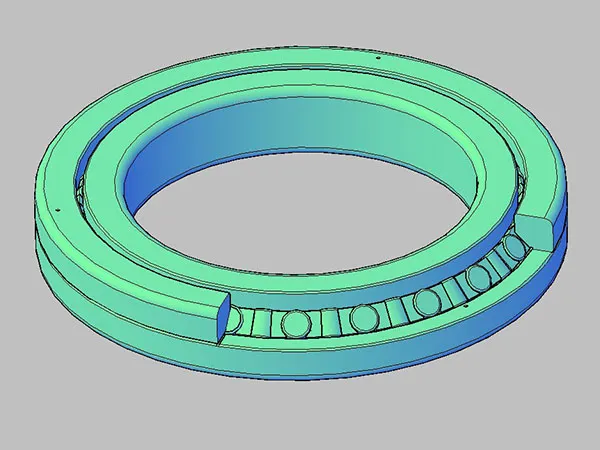
Choosing the right grease for a crossed roller bearing is essential for its performance, longevity, and reliability. The wrong grease can lead to premature failure, excessive friction, and heat generation. The selection process depends on several critical factors related to the bearing’s operating conditions.

crossed roller bearing

Key Factors for Grease Selection

Operating Temperature: This is one of the most important factors. The grease must be able to perform effectively within the temperature range of the application.

Base Oil Viscosity: The viscosity of the base oil (the lubricant component) changes with temperature. It’s crucial that the base oil maintains sufficient viscosity at the operating temperature to form a protective lubricating film.

Dropping Point: The dropping point is the temperature at which the grease changes from a semi-solid to a liquid. The operating temperature should be well below the grease’s dropping point (typically by 10-20°C for mineral greases and 20-30°C for synthetic greases).

Types of Grease: Different thickeners and base oils are suited for different temperature ranges. For example, synthetic greases are often used for extreme high or low temperatures.

Loads: The load on the bearing determines the required film strength of the grease.

High Loads: Applications with heavy or shock loads require grease with a higher base oil viscosity and, often, with Extreme Pressure (EP) additives. These additives create a protective layer to prevent metal-to-metal contact under high pressure.

Low Loads: For lighter loads, a lower viscosity grease is generally sufficient.

Speed (Rotational Speed): The rotational speed of the bearing is a key factor in selecting both the base oil viscosity and the grease consistency (NLGI grade).

High Speeds: High speeds generate more friction and heat. A lower viscosity base oil and a softer consistency grease (lower NLGI number, e.g., NLGI 1 or 2) are typically used to minimize friction and allow for better heat dissipation.

Low Speeds: Very low-speed applications with heavy loads may benefit from a higher viscosity base oil and a stiffer grease (higher NLGI number) to ensure the lubricating film is maintained.

Environment: The operating environment can introduce contaminants or moisture that affect the grease’s performance.

Dust and Contaminants: Grease acts as a sealant to prevent contaminants from entering the bearing. A stiffer grease (higher NLGI grade) is often better for this purpose.

More detailed information on how to choose grease for crossed roller bearings can be found at:https://www.prsbearings.com/a/news/grease-selection-for-cross-roller-bearings.html

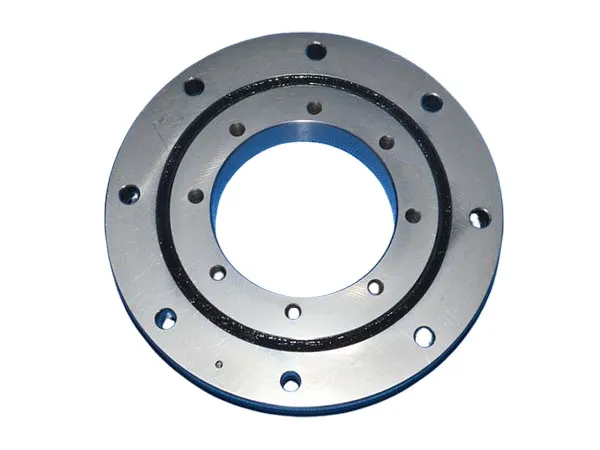
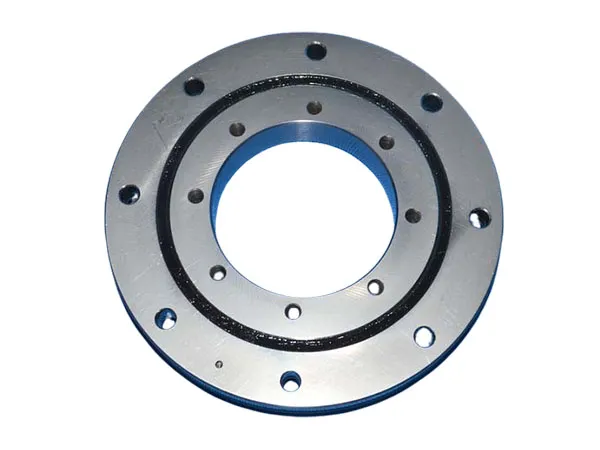
Adjusting the preload of a crossed roller bearing is critical for achieving optimal performance, stiffness, and accuracy. It’s the process of applying a controlled internal load during assembly to remove internal clearance and ensure the bearing’s rollers and raceways are in continuous contact.

Common Methods for Preload Adjustment

crossed roller bearing

The specific method for adjusting preload depends on the bearing’s design and application. Here are the most common approaches:

Split Inner Ring or Outer Ring: Some crossed roller bearings are manufactured with a split inner or outer ring. During assembly, this split ring is compressed or expanded, often by a locknut or screws, to create the desired preload. This method is common for bearings used in high-precision applications like machine tool spindles and robotic joints.

Using Shims and Spacers: This method involves inserting precise shims, sleeves, or spacers between bearing rings or between the bearing and its housing. By carefully selecting the thickness of these components, the axial distance between the bearing races is controlled, thus setting the preload. This is a very accurate method, often used in individual bearing arrangements.

Adjustment Screws: For linear crossed roller guides and some rotary applications, preload is adjusted using a series of set screws along an adjustable rail. The screws are tightened in a specific sequence to apply even pressure and remove play. The technician checks for smooth movement by hand to confirm the correct preload has been achieved. Over-tightening can cause excessive friction and damage.

More detailed information on how to adjust the preload of crossed roller bearings can be found at:https://www.prsbearings.com/a/news/adjustment-of-preload-in-crossed-roller-bearings.html

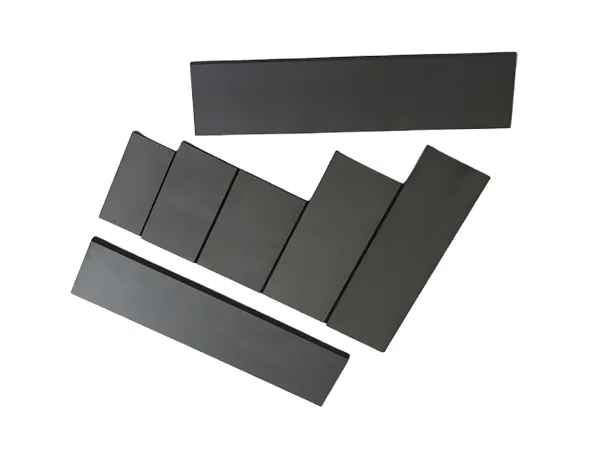
Graphite and its advanced derivatives, like carbon-carbon composites (CFC), are indispensable materials in the modern heat treatment industry. Their unique combination of thermal, chemical, and physical properties makes them superior to metals and ceramics for many high-temperature applications. Heat treatment processes—such as annealing, hardening, brazing, sintering, and carburizing—rely on precise temperature control in highly demanding environments, conditions for which graphite is exceptionally well-suited.

Key Properties of Graphite for Heat Treatment

graphite products in heat treatment industry

Before diving into the applications, it’s crucial to understand why graphite is the material of choice.

High-Temperature Stability: Graphite does not melt at atmospheric pressure; it sublimes at approximately 3,650°C (6,600°F). Its mechanical strength actually increases with temperature, peaking at around 2,500°C, a property unmatched by metals which weaken significantly as they get hotter.

Excellent Thermal Shock Resistance: Graphite can withstand rapid heating and cooling cycles without cracking or failing. This is due to its high thermal conductivity and very low coefficient of thermal expansion.

Chemical Inertness: In a vacuum or an inert/reducing atmosphere, graphite is extremely stable and does not react with most metals, alloys, or process gases, preventing contamination of the workpieces.

High Thermal Conductivity: It efficiently and uniformly transfers heat, which is critical for ensuring that all parts in a furnace load reach the same temperature at the same time.

Low Coefficient of Thermal Expansion (CTE): Graphite expands and contracts very little with temperature changes. This dimensional stability is crucial for fixtures and jigs that must hold parts to tight tolerances throughout a heat treatment cycle.

Machinability and Design Flexibility: Despite its hardness, graphite is easily machined into complex shapes, allowing for the creation of custom fixtures, heating elements, and intricate furnace components.

Lightweight: Graphite has a low density compared to refractory metals like molybdenum or tungsten, making furnace fixtures easier to handle and reducing the thermal mass of the furnace, which can lead to faster cycle times and energy savings.

Electrical Conductivity: This property allows graphite to be used directly as a resistive heating element, simplifying furnace design.

Major Applications of Graphite Products

graphite products in heat treatment industry

Graphite products are used extensively for both the internal components of the furnace (“the hot zone”) and for the tooling that holds the workpieces.

For more detailed information on the advantages of graphite products in the heat treatment industry, please click here:https://www.czgraphite.com/a/news/application-of-graphite-products-in-heat-treatment-industry.html

Customizing a graphite rack for a vacuum furnace is a critical process for optimizing throughput, ensuring part quality, and maximizing the lifespan of your furnace components. A well-designed custom rack can make a significant difference in your operations.Customizing a vacuum furnace graphite rack involves a collaborative process with a manufacturer to design and fabricate a rack that meets your specific application needs.

Why Customize? The Benefits

Maximize Load Capacity: Fit more parts in each cycle, increasing throughput.

Improve Part Quality: Ensure uniform heating and gas flow around each part, reducing warpage and ensuring consistent metallurgical properties.

Prevent Contamination: Hold parts securely without direct contact where it’s not desired, and use the right material grade to prevent reactions.

Enhance Ergonomics: Design for easy loading and unloading, reducing operator strain and cycle time.

Increase Rack Lifespan: Use the appropriate material and structural design to withstand thermal cycles and mechanical stress.

Vacuum Furnace Graphite Rack Customization Process

Vacuum Furnace Graphite Rack

The process typically follows these steps:

Step1: Define Your Requirements

Needs Assessment: You provide the manufacturer with the specifics of your application. This includes:

Part Geometry and Size: The dimensions and shape of the parts you will be placing in the rack.

Loading and Weight: The total weight of the parts the rack needs to support.

Operating Temperature: The maximum temperature the rack will be subjected to inside the furnace.

Required Durability: How long you expect the rack to last and how many thermal cycles it needs to endure.

For more detailed information on how to customize vacuum furnace graphite rack, please click here:https://www.czgraphite.com/a/news/customized-graphite-rack-for-vacuum-furnaces.html

To extend the service life of a vacuum furnace graphite rack, you need to focus on preventive maintenance, proper handling, and material selection. The primary causes of degradation are oxidation, thermal shock, and physical damage.

How to Extend the Service Life of Vacuum Furnace Graphite Rack

Vacuum Furnace Graphite Rack

Material Selection and Design

The service life of a graphite rack starts with the materials used and the design. While standard graphite is a good choice, carbon fiber composite (CFC) is often a superior material for racks and fixtures. CFC is made of carbon fibers in a carbon matrix, offering higher strength and rigidity, and is more resistant to fracture than basic graphite.

Carbon Fiber Composite (CFC): This material is lightweight, strong, and highly resistant to warping or distortion under high temperatures. Its lower thermal expansion helps prevent cracking caused by thermal cycling.

Coatings: Applying a protective coating, such as a silicon carbide-based graphite coating, can significantly extend the life of the rack by protecting it from wear, oxidation, and corrosion. This is especially useful in environments where there’s a risk of contaminants.

Design for Durability: Choose rack designs that minimize stress points and allow for even heat distribution. Machining holes into plates or using specific fixtures can help with cooling and prevent distortion.

Operational and Maintenance Practices

Proper handling and a consistent maintenance schedule are crucial for extending the life of your graphite rack.

Preventative Maintenance:

Daily Inspection: Visually inspect the rack daily for any signs of damage, such as cracks, broken pieces, or loose fasteners. Replace damaged components promptly.

Weekly Inspection: Hand-tighten nuts, bolts, and connectors to prevent arcing, which can burn away parts of the hot zone and degrade the rack. Avoid over-tightening, as this can break graphite elements.

For more detailed information on how to extend the service life of the vacuum furnace graphite frame, please click here:https://www.czgraphite.com/a/news/extend-the-service-life-of-vacuum-furnace-graphite-rack.html

Choosing the right heating method for a graphite crucible is crucial for effective and safe metal melting. The best choice depends on the specific application, including the type of metal being melted, the desired melting time, and the scale of the operation. The main heating methods are induction, electric resistance, and fuel-fired.

Graphite Crucible Heating Method

Graphite Crucible

Induction Heating

Induction heating uses an electromagnetic field to generate heat directly within the metal charge, or sometimes within the crucible itself. This method is known for its speed and efficiency.

How it works: An induction coil surrounds the crucible and creates a magnetic field. This field induces eddy currents in the metal, which in turn causes it to heat up and melt.

Crucible selection: For this method, you need a crucible that matches the furnace’s operating frequency. Low-frequency furnaces often require crucibles with high silicon carbide content to improve conductivity, while high-frequency furnaces may use clay graphite crucibles to manage the magnetic forces.

Pros: Very fast melting times, high energy efficiency, and precise temperature control.

Cons: Can be more expensive to set up than other systems and requires careful matching of the crucible to the furnace’s specifications to prevent overheating.

Best for: Processing precious metals, laboratory research, and applications where speed and precision are top priorities.

Electric Resistance Heating

Electric resistance furnaces use heating elements that get hot when an electric current passes through them, and this heat is then radiated to the crucible. This provides a clean and evenly distributed heat source.

How it works: The crucible is placed in a chamber surrounded by heating elements. Heat is transferred to the crucible and its contents by radiation and convection.

Crucible selection: Crucibles for this method must be designed for slower heating rates compared to fuel-fired furnaces. Using a crucible with a high graphite content in the carbon binder can enhance thermal conductivity and improve energy efficiency.

For more detailed information on how to choose the heating method of graphite crucible, please click here:https://www.czgraphite.com/a/news/graphite-crucible-heating-method.html

Customizing printed aluminum sheets is a fantastic way to create durable, high-impact visuals for everything from architectural panels and signage to fine art and custom products. Here is a comprehensive guide on how to do it, broken down into the methods, the step-by-step process, and key design considerations.

Customized Printed Aluminum Sheet Patterns

printed aluminum sheet

Understanding the Printing Methods

The first step is to choose the right printing technology for your project, as each has its own strengths in terms of durability, appearance, and cost.

1. Dye Sublimation (Most Popular for Fine Art & Photos)

This method produces stunning, photo-realistic results with incredible depth and vibrancy.

How it Works: Your design is printed onto special transfer paper with sublimation inks. The paper is then placed on a polymer-coated aluminum sheet and subjected to high heat and pressure. The ink turns into a gas and permeates the coating, becoming a permanent part of the surface.

Pros:

Exceptional photographic quality with continuous tones.

Highly durable, scratch-resistant, and easy to clean.

The image is in the surface, not on top of it.

Cons:

Requires specially coated aluminum sheets.

Standard inks can fade with prolonged, direct UV exposure (though UV-resistant options are available).

Best For: Fine art prints, high-end photography, interior signage, decorative panels, and custom backsplashes.

2. UV Direct Printing (Most Versatile)

This is a robust method where a flatbed printer applies ink directly onto the aluminum surface.
How it Works: The printer jets UV-curable ink directly onto the aluminum. A powerful UV light follows the print head, instantly curing (drying) the ink, making it hard and durable.

For more detailed information on how to customize printed aluminum plate patterns, please click here:https://www.dw-al.com/a/news/customized-printed-aluminum-sheet-patterns.html