
When fabricating large cylindrical structures such as tanks, pressure vessels, or industrial pipes, welding rotators are an essential piece of equipment. They ensure smooth rotation, precise alignment, and consistent weld quality. However, choosing the right welding rotator requires more than just knowing the weight of your workpiece—it’s critical to understand torque requirements. Selecting an undersized rotator can cause jerky motion, weld defects, or even equipment damage, while oversizing leads to unnecessary costs.
This guide will walk you through how to calculate torque accurately, factors that influence torque, and practical tips for selecting the optimal welding rotator.
Understanding Welding Rotator Torque
Torque is the rotational force a welding rotator applies to turn a workpiece. It is influenced by several variables, including weight, size, surface conditions, and speed. Understanding these factors helps you avoid common pitfalls in welding large cylindrical structures.
Choosing the correct torque ensures:
Smooth and consistent rotation
Higher weld quality with fewer defects
Longer service life of the equipment
Torque Calculation Basics
The torque (T) needed depends primarily on:
Workpiece weight (W)
Workpiece radius or diameter (R or D)
Friction coefficient (μ) between the rollers and the workpiece
Inclination angle (θ) if the workpiece is not perfectly horizontal
A simplified torque calculation formula is:
T=μ×W×R
Where:
T = Torque (N·m)
μ = Friction coefficient (dimensionless, usually 0.02–0.05 for steel on steel)
W = Load on the roller (N)
R = Radius of the workpiece (m)
Example Calculation:
For a steel cylinder weighing 5000 kg with a radius of 1 m and a friction coefficient of 0.03:
T=0.03×(5000×9.81)×1≈1471.5N\cdotpm
This gives a baseline torque. However, real-world conditions such as surface roughness, welding position, and rotation speed must also be considered. Relying solely on simplified formulas can lead to undersized or oversized selections.
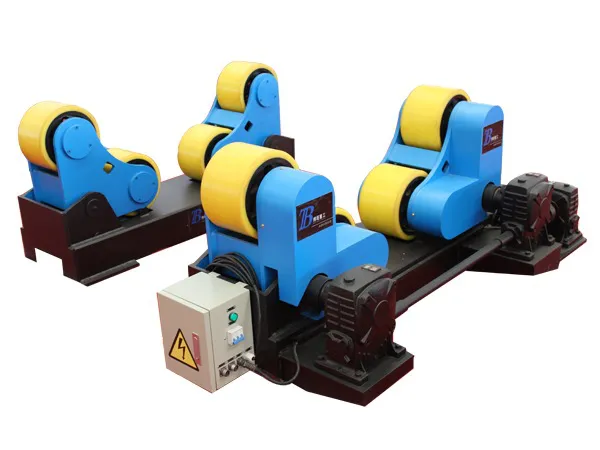
Key Factors Influencing Torque Requirements
1. Workpiece Material and Surface
Smooth, coated, or polished surfaces reduce friction, requiring less torque.
Rusty, wet, or painted surfaces increase resistance, demanding higher torque.
…
For more detailed information on welding rotator torque calculation and selection, please click to visit: https://www.bota-weld.com/en/a/news/welding-rotator-torque-calculation-and-selection.html