
Miniature satellites—often referred to as CubeSats or nanosatellites—have revolutionized space exploration by drastically reducing launch costs and enabling rapid deployment of constellations for Earth observation, communications, and scientific research. However, their compact form factor imposes severe constraints on every onboard component. Among the most challenging elements are the rotating mechanisms: reaction wheels, gimbals, solar panel drives, and deployable booms require bearings that are both extremely small and exceptionally precise. This is where thin-section bearings become indispensable. Unlike conventional ball bearings, thin-section bearings are designed with a radically reduced cross-section while maintaining high load capacity and rotational accuracy. They allow engineers to meet tight weight budgets, minimize friction in vacuum environments, and ensure long operational life without maintenance. In this article, we explore the critical role thin-section bearings play in miniature satellite mechanisms and why selecting the right supplier—such as BIBO Bearing—can make the difference between mission success and failure.
1. The Unique Demands of Miniature Satellite Mechanisms
Space Constraints and Weight Reduction
Every gram of mass in a miniature satellite comes at a premium. A 1U CubeSat (10×10×10 cm) typically weighs less than 1.33 kg, and mechanisms must fit within ever-shrinking envelopes. Standard deep-groove ball bearings, with their wide cross-sections, waste precious radial and axial space. Thin-section bearings, on the other hand, are engineered to have a cross-section that is a fraction of a standard bearing’s—often as thin as 2.5 mm or less—while still supporting the required loads. This enables designers to integrate rotating assemblies directly into compact housings without enlarging the overall satellite structure.
High Precision and Reliability Requirements
Satellite mechanisms must operate flawlessly for years in extreme conditions: vacuum, temperature swings from -50°C to +100°C, and exposure to radiation. A single bearing failure can disable a reaction wheel or jam a deployable antenna, rendering the satellite useless. Thin-section bearings are manufactured with tighter tolerances (e.g., ABEC 7/ISO P4 or better) to minimize runout and torque variation. Their reduced mass also means lower inertia, which is critical for attitude control systems that require rapid and precise angular adjustments. Furthermore, the use of specialized cage materials (e.g., phenolic or PEEK) and lubricants (such as perfluorinated oils or MoS₂ dry films) ensures reliable performance in vacuum without outgassing.
2. How Thin-Section Bearings Address These Challenges
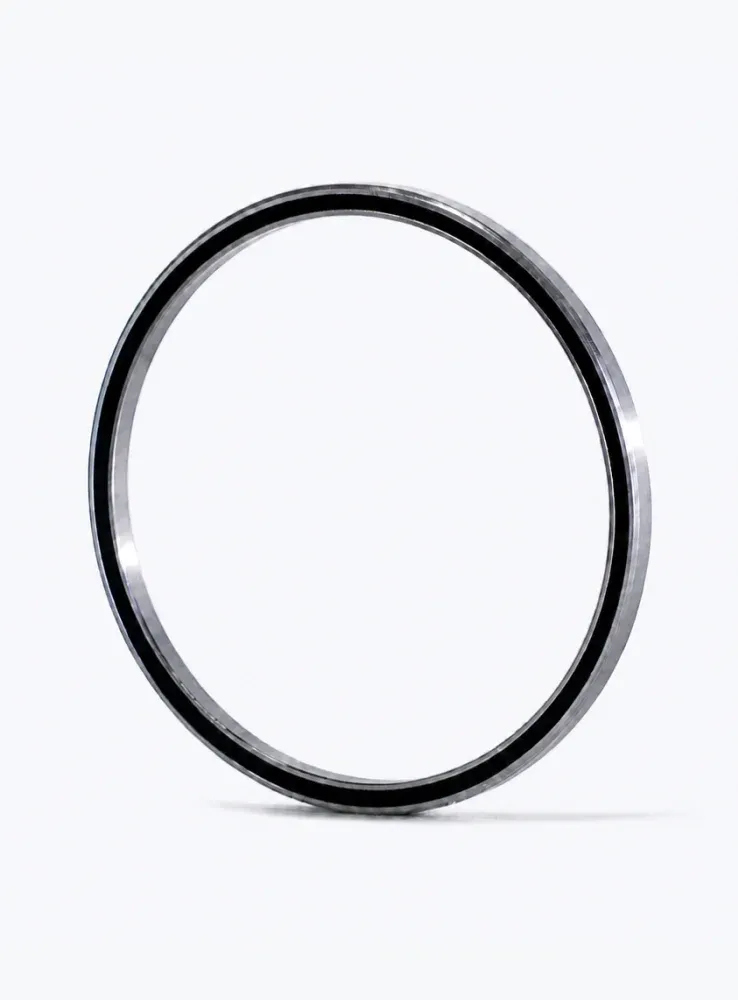
Cross-Sectional Geometry and Material Efficiency
The defining feature of a thin-section bearing is that its cross-section (the radial dimension from bore to outer race) remains constant for a given series, regardless of the bore diameter. For example, a K-series thin-section bearing has the same cross-section of 9.525 mm for bore sizes from 1 inch all the way up to 40 inches. This design philosophy allows engineers to scale down the bearing’s outer diameter proportionally to the shaft size, saving mass and space. For miniature satellites, special low-section stainless steel (AISI 440C or 9Cr18) or ceramic hybrid variants (with Si₃N₄ balls) provide corrosion resistance and reduced wear. The thin cross-section also reduces the overall rotating mass, lowering power consumption in motor-driven mechanisms.
…
For more detailed information on why thin-section bearings are crucial for microsatellite mechanisms, please click here: https://www.bobibearing.com/a/bearing-knowledge/role-of-thin-section-bearings-in-microsatellite-mechanisms.html