
Design engineers face constant pressure to shrink form factors without sacrificing performance. When every millimeter and gram matters—whether in robotics, medical imaging, or aerospace actuators—bearing selection becomes a critical optimization point. Crossed roller bearings offer a proven path to upgrade your design: they integrate high radial, axial, and moment load capacity into a single, compact ring that saves both space and weight compared to conventional bearing arrangements. This article examines the engineering rationale behind these savings and presents quantitative comparisons to help you evaluate whether a crossed roller bearing (specifically those from PRS) is the right choice for your next project.
Why Space and Weight Matter in Modern Machinery
Miniaturization trends across industries (from collaborative robots to satellite positioning mechanisms) demand components that deliver maximum stiffness and accuracy in minimal envelope. Traditional bearing solutions often require multiple bearings—a pair of angular contact bearings or a combination of a radial bearing with a thrust bearing—to handle combined loads. This multiplies the housing length, adds weight, and increases assembly complexity.
The Hidden Cost of Conventional Bearing Stacks
When a machine designer uses two separate bearings to manage axial and radial forces, the resulting stack-up must accommodate spacers, seals, and locking hardware. The total axial length can be 40–60% longer than a comparable crossed roller bearing, and the overall weight penalty often exceeds 30%. In applications like pan-and-tilt camera mounts or surgical robot wrists, every extra gram reduces acceleration capability and increases motor torque demand—direct costs in both energy and response time.
How Crossed Roller Bearings Achieve Space and Weight Reduction
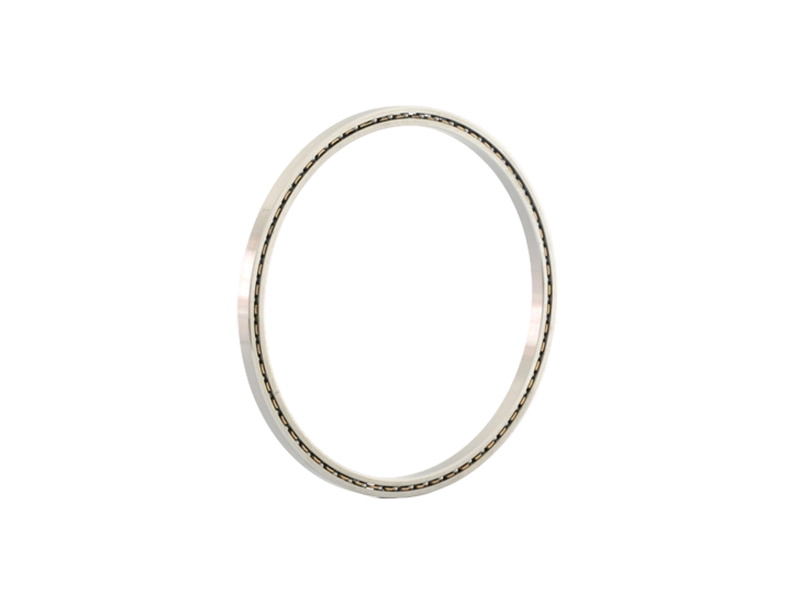
The defining geometry of a crossed roller bearing is a set of cylindrical rollers arranged alternately at 90° in one raceway. Each roller contacts the raceway in a cross pattern, sharing radial, axial, and moment loads across a single ring. This eliminates the need for a separate thrust bearing or a second row of balls.
Compact Cross-Section and Integrated Raceways
Because the raceway surfaces are precision ground directly into the inner and outer rings, there is no separate cage or spacer between rows. The roller pitch diameter can be placed closer to the mounting surfaces, reducing the overall bearing height. For a given bore size, a crossed roller bearing typically has a cross-section height that is 30–50% less than a deep-groove ball bearing of equivalent load rating, and often 20% less than a comparable cylindrical roller bearing with separate thrust elements.
…
For more details on upgrading your design: space and weight savings with crossed roller bearings, please click to visit: https://www.prsbearings.com/a/news/crossed-roller_bdb3a.html