
Every gram of mass removed from an unmanned aerial vehicle (UAV) directly contributes to longer mission endurance, higher usable payload, or greater flight agility. Yet in the search for lighter structural components, engineers frequently overlook a hidden heavyweight: the bearing assembly. For years, aerospace designers accepted the mass penalty of conventional bearings as unavoidable. That paradigm is shifting, largely because of precision thin section bearings, which offer a remarkable balance of reduced cross-section, low weight, and high load-carrying robustness. These compact rolling elements are enabling next-generation rotorcraft, gimbal systems, and surveillance turrets to shed structural weight without sacrificing the rigidity needed for stable flight performance. For design teams evaluating bearing options, understanding the mechanical and operational advantages of thin section technology is essential to making an informed specification decision.
Why UAV Engineering Demands a New Class of Bearings
The structural requirements of a UAV flight control system are unforgiving. Unlike ground-based machines that can tolerate heavier actuation components, a UAV must allocate its takeoff mass with precision. Each bearing in the gimbal, actuator linkage, or propeller pitch control mechanism affects the mass of the supporting bracket, the motor sizing, and ultimately the battery capacity. A heavier bearing therefore cascades into a heavier aircraft at multiple levels of the system architecture.
Conventional bearings, designed decades ago, maintain cross-sections that are often oversized for modern UAV applications. They are built for heavy-duty industrial shafts with standardized load-carrying conventions, offering far higher load ratings than a small aerial platform will ever encounter. The result is an unnecessary weight and space penalty inside precision mechanisms where every millimeter of envelope matters.
What Exactly Are Thin Section Bearings?
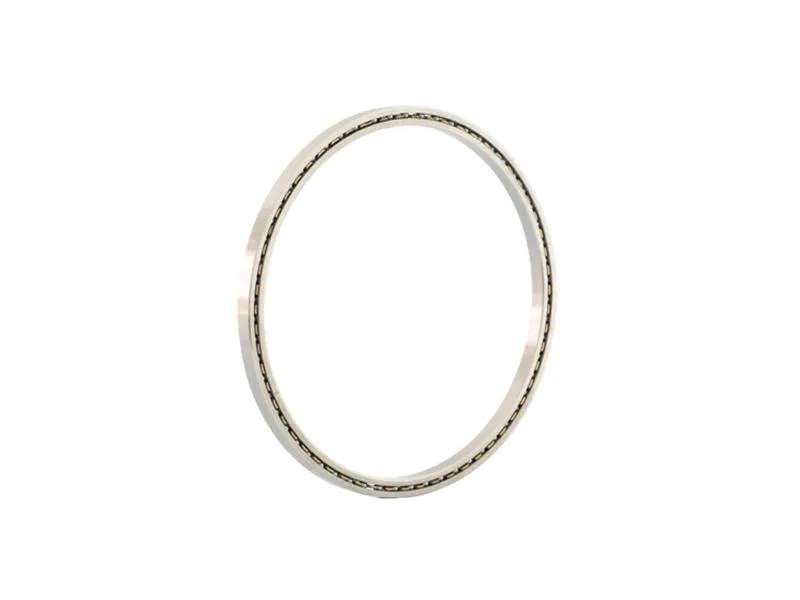
A thin section bearing is defined by its cross-sectional geometry, not by its bore diameter. Where a standard ball bearing has a cross-section that scales proportionally with the bore, a thin section bearing maintains a small, reduced cross-section across a wide range of bore sizes. This allows engineers to use a large-diameter bearing for moment stability and drift resistance without carrying the associated bulk and mass of a traditional bearing.
…
Click here for more details on lightweight yet robust thin-section bearings for drones: https://www.prsbearings.com/news/uav-bearing-guide/