
When engineers evaluate bearing solutions for high-precision equipment, rigidity becomes a decisive factor rather than just a performance metric. Whether the application involves CNC machine tools, industrial robots, medical devices, or semiconductor equipment, insufficient rigidity often leads to vibration, positioning errors, and premature wear. This article explains the real differences between crossed roller bearings and angular contact ball bearings, with a strong focus on rigidity, helping you make a technically sound and commercially practical choice.
Understanding Rigidity in Bearing Applications
Rigidity refers to a bearing’s ability to resist deformation under load. In practical terms, it determines how much displacement occurs when forces act on the system. A bearing with high rigidity maintains positional accuracy, reduces deflection, and improves machining quality or motion stability.
Rigidity depends on several factors:
Contact geometry between rolling elements and raceways
Internal clearance or preload
Material properties and heat treatment
Load direction and distribution
Both crossed roller bearings and angular contact ball bearings are designed for precision applications, but their internal structures lead to very different rigidity characteristics.
What Is a Crossed Roller Bearing?
A crossed roller bearing features cylindrical rollers arranged orthogonally (at 90 degrees) between inner and outer rings. Each roller alternates in orientation, allowing the bearing to handle radial, axial, and moment loads simultaneously.
Key Structural Advantage
Because rollers have line contact with raceways, the load distributes over a larger contact area compared to point contact in ball bearings. This design significantly increases stiffness.
Rigidity Performance
Crossed roller bearings typically deliver:
Extremely high rigidity under multi-directional loads
Minimal elastic deformation
Superior resistance to tilting moments
This makes them ideal for applications where even micron-level deflection is unacceptable.
What Is an Angular Contact Ball Bearing?
An angular contact ball bearing uses balls as rolling elements, with raceways designed to support loads at a specific contact angle. These bearings are often installed in pairs or sets to handle combined loads.
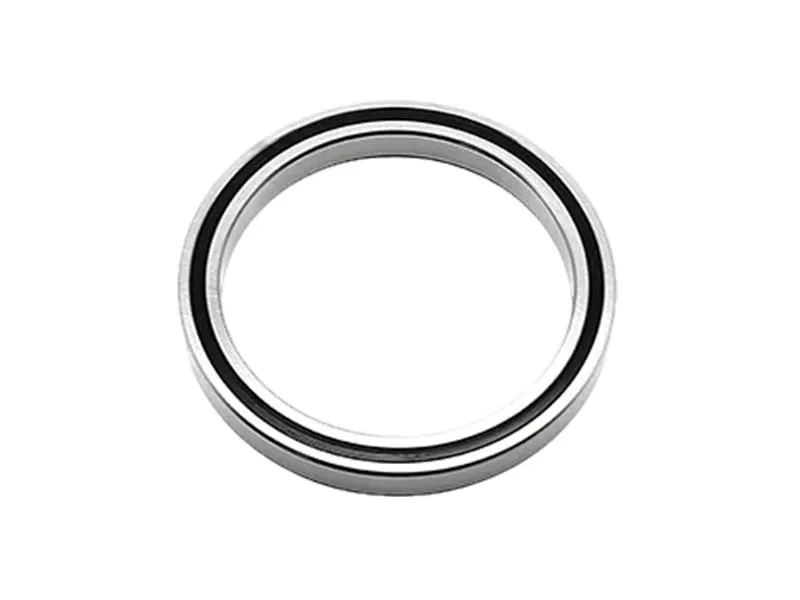
Key Structural Advantage
The point contact between balls and raceways reduces friction and allows for higher rotational speeds. Engineers often use preload configurations to enhance stiffness.
Rigidity Performance
Angular contact ball bearings provide:
Moderate to high rigidity depending on preload
Good axial load support in one direction (or both when paired)
Flexibility in configuration (back-to-back, face-to-face, tandem)
However, due to point contact, their inherent rigidity is lower than that of roller-based designs.
…
For more detailed information about crossed roller bearings and angular contact ball bearings, please click to visit: https://www.prsbearings.com/a/news/difference-between-crossed-roller-bearings-and-angular-contact-ball-bearings.html