
Industrial gearboxes convert speed and torque under continuous load, and the bearings inside them determine how reliably that conversion holds up over years of service. Cylindrical roller bearings occupy a specific and important place in this system: line contact between rollers and raceways gives them high radial load capacity relative to their size, along with the stiffness that accurate gear meshing demands. They are not a universal substitute for deep groove ball bearings or tapered roller bearings, however. Selecting the right configuration such as NU, NJ, NUP, or N, and matching it to the gearbox’s axial location strategy, lubrication method, and duty cycle is what separates a design that runs reliably from one that fails early. This article explains how these bearings function in gearbox applications and what to verify before specifying them.
Why Cylindrical Roller Bearings Suit Gearbox Shaft Support
Gearbox shafts carry a combination of loads: the radial forces generated by gear mesh, the weight of the shaft and attached components, and the axial forces created by helical or bevel gearing. Cylindrical roller bearings are typically chosen for the radial portion of that duty because their geometry handles it more efficiently than ball bearings of comparable envelope size.
Radial load capacity and stiffness
In a cylindrical roller bearing, the roller contacts the raceway along a line rather than at a single point. The load is distributed over a larger contact area, which reduces contact stress and allows the bearing to carry a substantially higher radial load within the same bore and outer diameter. Just as importantly, the resulting radial stiffness is high, which limits shaft deflection under fluctuating gear loads. Reduced deflection means more consistent tooth contact patterns, lower noise, and less risk of edge loading on the gear teeth.
Speed capability and thermal behaviour
Because cylindrical rollers are guided between ribs or by a cage rather than being retained by shoulders in all directions, friction is comparatively low. Many designs run cooler than equivalently loaded tapered roller bearings, which matters in gearboxes where oil viscosity and film thickness depend on stable operating temperature. The trade-off is that cylindrical roller bearings generally cannot absorb the combined radial and axial loading that tapered bearings handle, so the axial location of the shaft must be managed separately.
Common Cylindrical Roller Bearing Configurations in Gearboxes
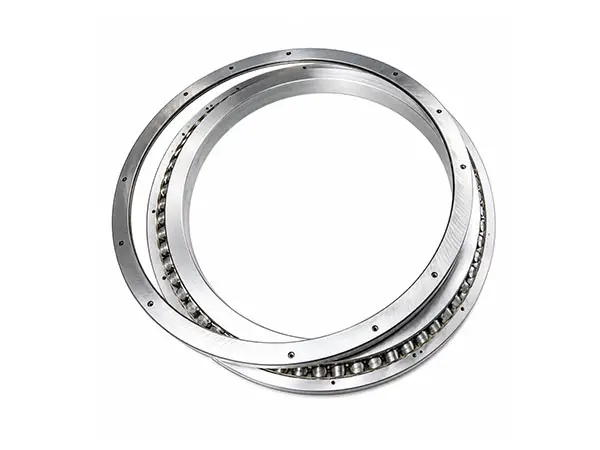
The rib arrangement on the inner and outer rings determines what each design can and cannot do. Misidentifying these variants is one of the most common causes of premature failure in gearbox rebuilds, because a bearing chosen for its radial capacity alone may not be able to take the axial load the shaft imposes on it.
…
For more detailed information on cylindrical roller bearings in industrial gearboxes, please click here: https://www.chgbearingtech.com/blog/gearbox-bearings/