
In the competitive glass processing industry, reducing production time without compromising quality is the single most effective way to increase throughput and profitability. Yet many manufacturers still rely on manual cutting methods that are slow, labor-intensive, and prone to measurement errors. The headline promise of a 40% reduction in production time is not marketing hyperbole—it is a measurable outcome achieved by integrating advanced automation into the cutting process. This article examines how DISAI’s automated glass cutting table achieves this dramatic improvement, the engineering principles behind it, and what it means for your facility’s bottom line.
Why Traditional Glass Cutting Falls Short
Manual glass cutting requires skilled operators to measure, mark, and score each piece individually. Even with years of experience, human hands introduce variability: cut lines deviate by fractions of a millimeter, glass breakage occurs due to uneven pressure, and every new job requires time-consuming re-measurement. These inefficiencies accumulate, especially in high-mix, low-volume production where patterns change frequently.
According to industry studies, manual cutting operations spend up to 30% of shop-floor time on set-up and measurement rather than actual cutting. On a standard 8-hour shift, that equates to over two hours of non-productive work. For a facility processing 100 sheets daily, the cost of that lost time is substantial—in labor wages, machine idle time, and delayed downstream operations.
The DISAI Automated Glass Cutting Table: Engineering for Speed
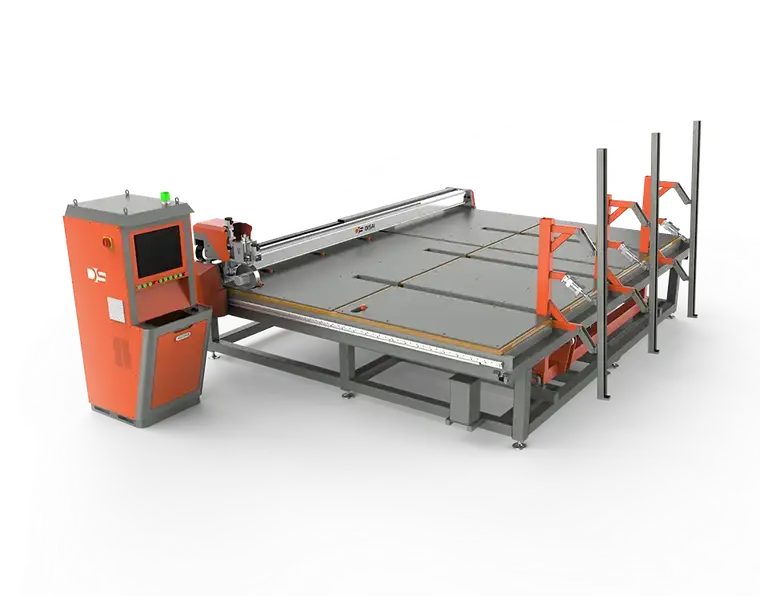
DISAI has re-engineered the glass cutting table from the ground up, integrating CNC precision, linear motor drives, and intelligent software to eliminate the bottlenecks that plague conventional methods. The result is not just a machine but a complete system designed for continuous, high-accuracy production.
CNC-Controlled Cutting Head: Precision at High Velocity
At the core of the table is a servo-driven cutting head that moves along the X and Y axes under computer numerical control. Unlike manual scoring, the head maintains a constant distance from the glass surface, ensuring consistent pressure across the entire cut. This reduces edge chipping and internal micro-cracks, which in turn lowers breakage rates during subsequent handling and tempering.
Optimized Cutting Path Algorithm
The DISAI software automatically calculates the most efficient cutting sequence based on your nesting layout. It minimizes the unproductive travel distance between cuts, sequences straight lines and curves without unnecessary stops, and even adjusts cutting speed based on glass thickness. This algorithmic optimization alone can reduce cycle time by 15% to 25% compared to manual path planning.
Automatic Sheet Loading and Positioning
With optional loading bridges and alignment systems, the table can automatically pick up glass sheets from an A-frame rack, position them within 0.2 mm accuracy, and begin cutting without operator intervention. This eliminates the repetitive lifting, aligning, and clamping tasks that consume valuable minutes between each sheet.
Measurable Impact: 40% Production Time Reduction in Practice
To understand where the 40% time saving comes from, consider a typical job processing 200 pieces of 8 mm float glass across 40 unique shapes. On a manual cutting table, an experienced operator would spend:
…
Learn more about how automated glass worktables can reduce production time by 40%. Click here for details: https://www.disaiglass.com/industry-news/glass-cutting-table/