
In modern industrial applications, the demand for compact, high-precision rotational components has grown significantly. Thin section bearings have emerged as a solution, providing exceptional performance in confined spaces without compromising load capacity or rotational accuracy. Among the diverse designs available, the choice of contact style plays a pivotal role in determining the bearing’s performance under varying operating conditions. This article explores thin section bearing Type A vs Type C vs Type X contact styles, highlighting their structural differences, operational advantages, and industry applications.
What Are Thin Section Bearings?
Thin section bearings are specialized bearings characterized by their small cross-sectional height relative to their bore diameter. This design enables engineers to integrate rotational components into applications where conventional bearings would be too bulky or heavy. Despite their reduced profile, these bearings maintain high load-carrying capacity, rigidity, and operational precision, making them ideal for robotics, aerospace, medical devices, and automation equipment.
The contact style of a bearing, which refers to how the rolling elements interact with the raceway surfaces, significantly impacts its axial and radial load handling, rotational smoothness, and resistance to misalignment. Understanding the distinctions among Type A, Type C, and Type X contact styles is crucial for engineers seeking optimal performance in thin section bearing applications.
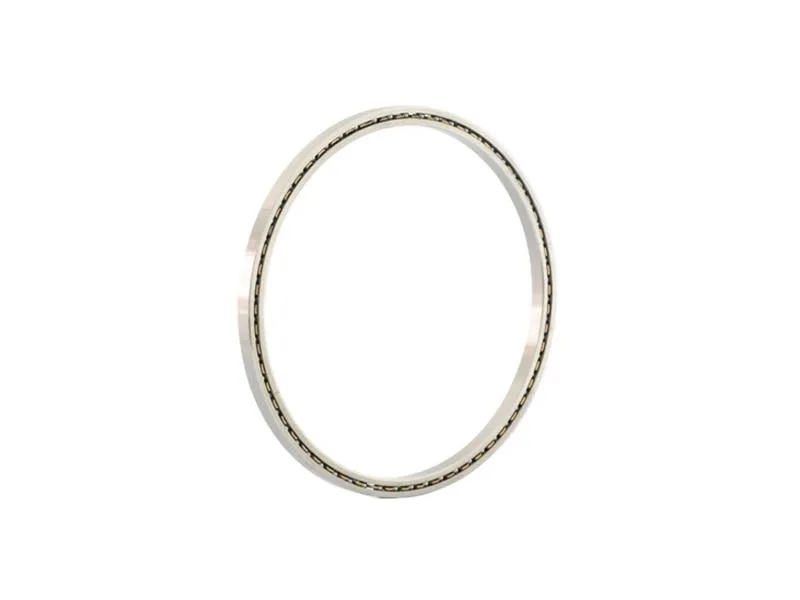
Type A Contact Style: Angular Contact with Standard Load Distribution
Type A thin section bearings utilize an angular contact design where the rolling elements make contact with the raceways at a moderate angle. This configuration allows the bearing to handle both radial and moderate axial loads in one direction. The Type A style is especially beneficial in applications requiring precise axial positioning while maintaining high rotational accuracy.
Advantages:
Balanced load distribution between radial and axial directions.
High rotational accuracy suitable for robotic joints and positioning systems.
Versatility in handling moderate axial forces without the need for additional support bearings.
Limitations:
Axial load capacity is directional; misalignment can reduce performance.
Not ideal for applications with high axial loads in both directions simultaneously.
Industries such as semiconductor equipment manufacturing and precision assembly machinery often favor Type A thin section bearings for their combination of compact size and balanced load handling.
…
For more detailed information on the thin section bearing type A vs type C vs type X contact styles, please click to visit:https://www.prsbearings.com/a/news/thin-section-bearing-type-a-vs-type-c-vs-type-x-contact-styles.html