
In modern high-precision equipment design, thin section ball bearings are no longer a niche component—they have become a strategic choice in industries where space, weight, and performance must be optimized simultaneously. From aerospace actuation systems and robotic joints to medical imaging devices and semiconductor equipment, these bearings enable engineers to achieve compact architectures without sacrificing rotational accuracy.
However, the same design characteristics that make thin section ball bearings highly efficient—reduced cross-section, lightweight construction, and tight tolerances—also make them more sensitive to real-world operating conditions. In practical applications, premature failure is rarely accidental; it is typically the result of overlooked details in lubrication, installation, load management, or environmental control.
Causes of Premature Failure in Thin Section Ball Bearings
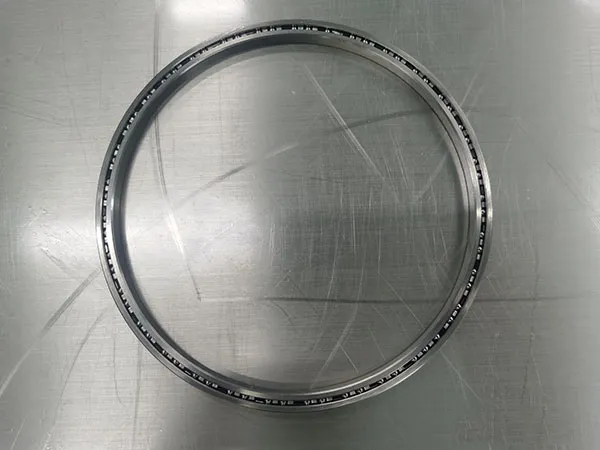
This article does not simply list common causes. Instead, it provides a deeper, experience-driven analysis of why failures occur, how they develop over time, and what engineers and maintenance teams can do to prevent them in real operating environments.
1. Lubrication Deficiency: A Subtle but Critical Failure Trigger
In theory, lubrication is straightforward. In practice, it is one of the most misunderstood aspects of thin section bearing performance.
Due to their slim geometry, thin section ball bearings have limited internal space for lubricant retention. This means that unlike conventional bearings, they cannot rely on large grease reservoirs to compensate for suboptimal lubrication practices. Once the lubricant film breaks down, direct metal contact begins almost immediately.
The issue is not always a lack of lubricant—it is often incorrect lubrication strategy. For example, selecting a grease with inappropriate viscosity for high-speed applications can lead to excessive shear heating, accelerating degradation. Similarly, in low-speed but high-load environments, insufficient film thickness can cause micro-welding between contact surfaces.
Temperature also plays a critical role. In applications such as robotics or automated production lines, continuous operation leads to gradual heat buildup. Over time, this alters lubricant properties, reducing its ability to maintain a stable film between rolling elements and raceways.
…
For more detailed information on the causes of premature failure in thin-section ball bearings, please click to visit: https://www.lynicebearings.com/a/blog/causes-of-premature-failure-in-thin-section-ball-bearings.html