
In CNC machine tools, machining accuracy depends on the performance of every load-bearing component. Crossed roller bearings play a particularly critical role in determining whether a cutting tool can hold micron-level tolerances. Unlike standard ball bearings or tapered roller bearings, crossed roller bearings arrange cylindrical rollers in an alternating 90-degree pattern, allowing a single bearing to handle radial, axial, and moment loads simultaneously. This configuration reduces the number of components in a machine assembly, lowers cost, and improves overall system rigidity. The sections below explain why crossed roller bearings matter, how they compare with alternatives, and what to consider when selecting them for a machine tool application.
Why Crossed Roller Bearings Matter in CNC Machine Tools
The core value proposition of a CNC machine tool is repeatable precision. Every axis that positions a tool relative to a workpiece needs support that is both rigid and stable. Crossed roller bearings deliver this because the rolling elements inside are cylindrical rollers—not spheres. These rollers are arranged in an alternating pattern, typically at 90 degrees to each other. The line contact between each roller and the raceway groove creates a high contact area that distributes load across the full length of the roller rather than concentrating it at a few points. The result is less elastic deformation under the combined loads that arise during cutting. For turning and milling operations, this matters because cutting forces rarely act in a single direction; they generate radial, axial, and moment loads at the same time.
Another advantage that is easy to overlook is space efficiency. A single crossed roller bearing can replace two or more ball bearing sets—for example, a pair of angular contact bearings plus a thrust bearing. That reduces the overall axial length and weight of a machine design, which is especially valuable in rotary tables and spindle heads where multiple axes are packed into a confined space. A smaller bearing envelope also means less thermal expansion to manage, which itself is a precision factor over long machining cycles.
Key Performance Characteristics to Consider
- High rigidity: Line contact between rollers and raceways resists elastic deformation far better than the point contact of ball bearings.
- Rotational accuracy: Standard grades typically achieve runout values equivalent to ISO P5 or better, and higher grades are available for ultra-precision requirements.
- Low, consistent friction torque: The difference between starting and running torque is minimal, which supports repeatable servo control.
- Compact cross-section: A low section height allows these bearings to fit into thin-walled housings without sacrificing load capacity.
- Mounting flexibility: Available with or without mounting holes, with or without seals, and with optional gear teeth for direct drive integration.
Crossed Roller Bearings vs. Alternative Bearing Types
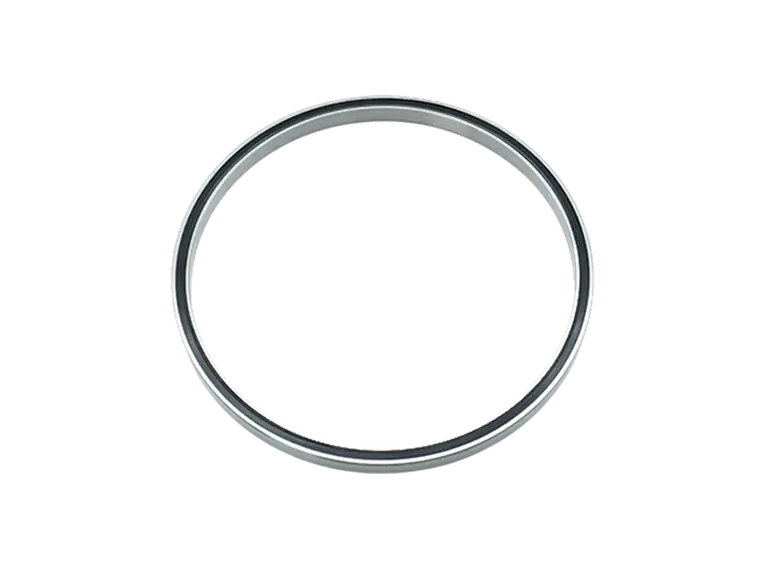
Before committing to a crossed roller bearing, engineers often compare it against two or three other options. The point of the comparison is not to declare one bearing type universally superior, but to evaluate which one delivers the best balance of rigidity, accuracy, and total cost for a specific machine architecture.
…
For more detailed information on crossed roller bearings for CNC machine tools, please click here: https://www.prsbearings.com/news/crossed-roller-bearings-for-cnc-machine-tools/