
Crossed roller bearings are rarely the most visible part of a machine, yet they often decide how accurately it moves. Because a single unit carries radial, axial and tilting moment loads at the same time, engineers specify them whenever a rotating axis must stay rigid, repeatable and compact. That combination appears across robotics, machine tools, semiconductor equipment, medical imaging and aerospace instrumentation, where a few micrometres of error become a product defect or a failed inspection. This guide reviews the most common applications of crossed roller bearings, explains why they are chosen over alternative arrangements, and outlines the factors that matter most when specifying one for a new design.
How a Crossed Roller Bearing Works and Why It Matters
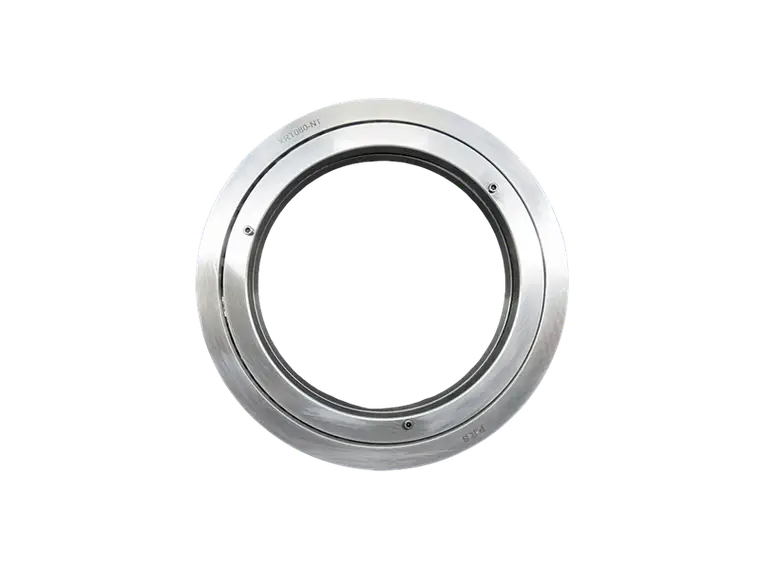
In a crossed roller bearing, cylindrical rollers are arranged in an alternating sequence, each rotated 90 degrees relative to its neighbour, and held apart by spacers or a cage. The raceways are ground as V-shaped grooves with a 90-degree included angle, so every roller contacts the raceway along two lines. The result is a bearing that handles radial loads, axial loads in both directions and tilting moments simultaneously, without a second bearing to control the moment.
That single-bearing load capability has direct design consequences. The axis becomes shorter, the housing simpler and the stiffness higher, because the rolling elements run in line contact rather than point contact. Compared with a pair of angular contact bearings, the assembly needs less axial space, fewer components and less adjustment during mounting. For applications where positioning accuracy and repeatability are the primary requirements, this is often decisive.
Top Applications of Crossed Roller Bearings
Industrial and Collaborative Robots
Robot joints are among the most demanding duties for any precision bearing. A shoulder, elbow or wrist axis must support a payload at the end of a long lever arm, which generates significant tilting moment, while still holding repeatability in the sub-0.1 mm range through millions of cycles. Crossed roller bearings are commonly fitted at the output of harmonic and cycloidal drive units and at the base rotation of articulated arms, where their rigidity limits deflection under load and their compact height keeps the joint envelope small. In collaborative robots, smooth running and low backlash also matter for force control and for safe, predictable motion.
…
For more detailed information on the primary applications of crossed roller bearings, please click here: https://www.prsbearings.com/news/top-applications-of-crossed-roller-bearings/