
If you are considering a horizontal refrigerator for a kitchen, garage, or commercial space, noise is one of the first practical questions that comes up. Unlike upright models, horizontal refrigerators place the compressor and condenser inside a low, wide cabinet, and that layout changes both how loud the unit sounds and how that sound travels through a room. Most horizontal refrigerators run somewhere between 35 and 50 decibels, but the gap between a well-built unit and a budget one becomes obvious within minutes of switching it on. This guide explains what noise levels are realistic, what causes excessive noise, and how to choose a model that stays quiet for years.
What Noise Levels Should You Expect from a Horizontal Refrigerator?
Manufacturers rarely print decibel ratings on the spec sheet, so buyers usually rely on guesswork or user reviews. In practice, horizontal refrigerators measured with a sound meter at roughly one meter distance tend to fall into a fairly predictable band:
- 32–38 dB: Premium horizontal refrigerators with inverter compressors and thick insulation. Roughly the sound of a quiet bedroom at night.
- 38–44 dB: The typical range for mid-range residential horizontal refrigerators and chest freezers. Similar to a soft conversation or a library.
- 45–52 dB: Entry-level or older units. Audible across an open-plan room, especially at night.
- Above 55 dB: Usually a symptom rather than a design feature — poor leveling, a failing compressor mount, or restricted airflow around the condenser.
Treat these as realistic expectations rather than guarantees. Ambient temperature, load level, and how well the cabinet is leveled all shift the final number by several decibels.
How to Interpret Decibel Ratings Correctly
Decibels are logarithmic, which means the numbers do not scale the way people assume. A 10 dB increase is perceived as roughly twice as loud, not 10 percent louder. That is why the difference between a 38 dB unit and a 46 dB unit feels dramatic in a quiet kitchen, even though the numbers look close on paper.
Equally important is duty cycle. A horizontal refrigerator that runs at 42 dB for eight minutes per hour can be far less disruptive than a 36 dB unit that never switches off. When comparing models, consider both peak sound and how often the compressor cycles.
Why the Horizontal Design Often Runs Quieter
The low, wide cabinet is not just a storage decision — it has acoustic advantages. The compressor sits lower in the chassis, often on rubber vibration dampers, and the heavy insulated lid absorbs more sound than a thin upright door. Many horizontal models also use static cooling rather than a forced-air fan, which removes one of the most persistent noise sources in modern refrigerators.
Horizontal vs Upright Refrigerators: Noise Comparison
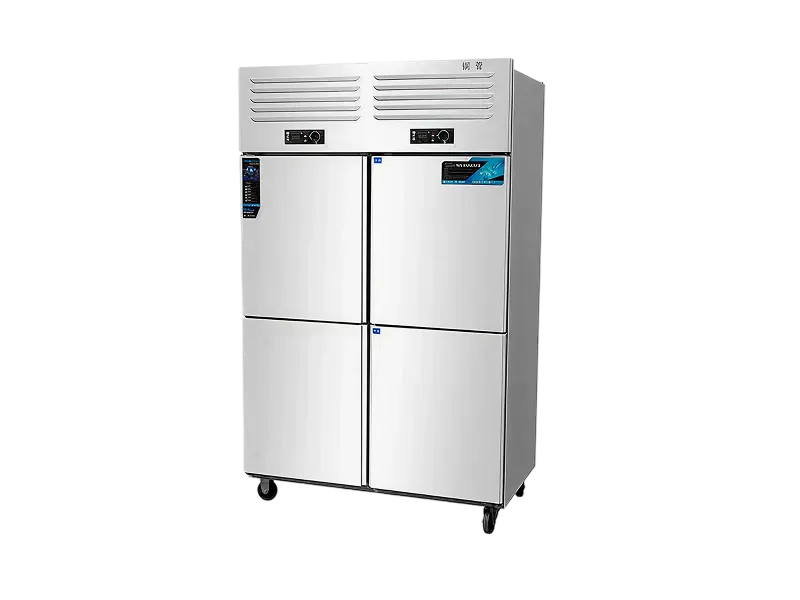
If quiet operation is a priority, the cabinet orientation matters more than most buyers expect. Horizontal refrigerators hold several structural advantages over comparable upright models:
- No circulating fan: Static-cooling horizontal units avoid the constant fan hum that no-frost uprights produce.
- Lower compressor vibration: A low center of gravity and cushioned mounting reduce the transfer of vibration into the floor.
- Shorter compressor runtime: Cold air stays inside when the lid opens, so the cabinet recovers temperature faster and cycles less often.
…
For more details on noise levels in chest freezers—including what to expect—please click here: https://www.tzykitchenware.com/a/news/horizontal-noise.html