
A small office rarely fails because of ambition. It struggles because of square footage. Desks that swallow walkways, filing cabinets that block doors, and chairs that never tuck away all chip away at the same limited space. Compact steel furniture addresses that problem without forcing you to accept flimsy, temporary-looking pieces. Steel frames are thin where wood panels are thick, rigid where particle board sags, and precise where cheap laminates wobble. LAKSHYO has worked with businesses operating in tight footprints for years, and one pattern holds true: the right steel configuration can add usable workspace without adding a single square meter. This guide explains what compact steel furniture solves, how it compares with conventional alternatives, and how to plan a small office that finally works.
Why Small Offices Outgrow Their Furniture So Quickly
Most office furniture is designed for rooms that have room to spare. A standard executive desk is 1.5 to 1.8 meters wide and 75 to 90 centimeters deep. Add a return unit, a pedestal drawer, a guest chair, and a filing cabinet, and a single workstation can consume six to eight square meters. In a room measuring fifteen square meters, that leaves almost nothing for movement.
The problem compounds because traditional furniture is volumetric rather than structural. A wooden desk uses thickness to create strength, which means every surface is surrounded by 18 to 25 millimeters of material that does nothing except occupy space. Multiply that across a desk, two storage units, and a meeting table, and you have lost a meaningful percentage of your floor area to material rather than function.
Compact steel furniture inverts that logic. Strength comes from the geometry of the steel section, not from bulk, so components stay slim without becoming fragile. That single design principle is why a steel-framed workstation can fit into a footprint where a similarly capable wooden one cannot.
What Compact Steel Furniture Actually Solves
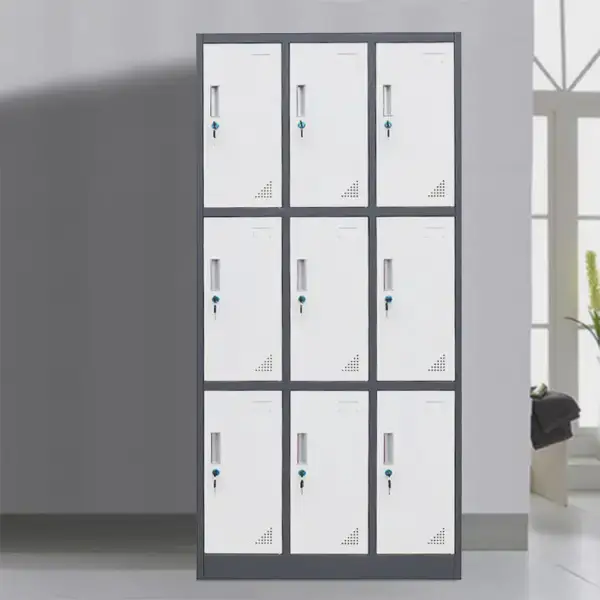
Thin Profiles Without Structural Compromise
Powder-coated steel legs and frames typically measure 25 to 50 millimeters across, compared with the bulk of a solid timber leg at 70 to 80 millimeters. On a single desk that difference is minor. Across four workstations arranged in a pod, it changes how much circulation space remains. Slim frames also make cables easier to route and cleaning easier to perform, because there are fewer deep crevices to reach into.
Vertical Storage in Vertical Space
Small offices usually have unused height. Steel shelving and tambour-door cabinets can rise to 1.8 or 2.1 meters while occupying a floor footprint of roughly 0.4 square meters. Because steel shelving carries high load ratings per shelf, you can consolidate documents, supplies, and equipment that were previously spread across multiple low cabinets. The floor area you recover is often more valuable than the storage you add.
Modular Configurations That Change With the Team
Steel systems are typically built from standardized frames, tops, and connectors. That means a bench desk for three people can become two desks and a storage wall without buying an entirely new set of furniture. For a small business whose headcount shifts, that flexibility has a direct financial value. LAKSHYO designs its compact steel ranges around this principle so components remain compatible across configurations.
…
Looking for options for a small office? Consider compact steel furniture solutions—click here for more details: https://www.lakshyofurniture.com/news-center/compact-steel-desk/