
Crossed roller bearings sit at the heart of positioning accuracy in CNC machines. A single wrong specification can introduce runout, reduce rigidity, or shorten service life, and the resulting scrap rate often costs far more than the bearing itself. For engineers and purchasing teams, the real challenge is not finding a supplier, but matching bearing type, precision grade, and stiffness to a specific axis, spindle, or rotary table. This guide explains the selection factors that matter most, the trade-offs behind each choice, and how to verify a supplier before committing to volume orders.
Why Crossed Roller Bearings Are Preferred in CNC Structures
Unlike standard ball bearings, a crossed roller bearing arranges cylindrical rollers at 90 degrees to each other, alternating in a single raceway. This layout lets one bearing absorb radial, axial, and moment loads simultaneously, which simplifies the surrounding mechanical design considerably.
For CNC applications the practical benefits are direct:
- Higher rigidity per unit volume, which reduces elastic deflection under cutting force
- Compact cross-section, allowing thinner rotary tables and joint arms
- Consistent torque across the rotation range, improving interpolation accuracy
- Reduced part count, since separate thrust and radial bearings are no longer required
These characteristics make crossed roller bearings a common choice for rotary tables, indexing heads, robotic joints, tool changers, and the tilt axes of five-axis machines.
Identify the Application Before Comparing Specifications
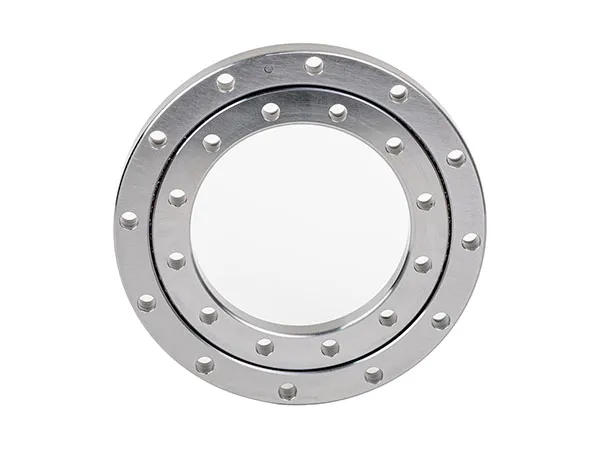
Selection starts with the axis itself, not the catalogue. A high-speed spindle axis and a slow rotary table demand very different bearings, even when their bore sizes match.
Define the Load Profile
Estimate the combined radial, axial, and moment loads, then apply a safety factor that reflects shock and intermittent cutting. Thin-section bearings are sensitive to moment load, so an underestimated overturning moment is one of the most frequent causes of premature failure.
Define the Motion Profile
Continuous rotation, oscillating motion, and indexing with frequent starts and stops each stress the raceway differently. Oscillating axes tend to show false brinelling if lubrication is inadequate, while indexing axes place more demand on cage or separator durability.
Define the Precision Requirement
Match the bearing’s running accuracy to the machine’s positioning tolerance rather than simply buying the highest grade available. Overspecifying precision adds cost without improving the finished part.
Match Bearing Type to the Axis
Crossed roller bearings for CNC equipment generally fall into a few practical categories:
- Separator-type (caged) bearings — rollers are kept apart by spacers, giving lower friction and better suitability for higher speeds.
- Full-complement bearings — maximum roller count and highest load capacity, but limited speed and higher friction.
- Open and sealed designs — sealed versions resist chips and coolant but run slightly warmer.
- Inner-rotation and outer-rotation variants — the mounting direction should follow how the machine structure transmits load.
…
For more detailed information on how to select crossed roller bearings for CNC machine tools, please click here: https://www.mcslewingbearings.com/a/news/cnc-crossed-roller.html