
Rotary tables are among the most demanding applications in precision machining, metrology, and automated assembly. They must rotate with exceptional accuracy while simultaneously supporting axial, radial, and tilting loads. The bearing selected for a rotary table directly determines its rigidity, positioning repeatability, and service life. Crossed roller bearings have emerged as the preferred solution for these challenges because their structure fundamentally addresses the load and precision requirements that conventional bearings struggle to meet.
What Makes Rotary Tables So Demanding for Bearings
A rotary table is not simply a rotating platform. It is a positioning system expected to hold angular accuracy in the arc-second range, resist deflection under cutting forces, and maintain smooth motion across a wide range of speeds. These requirements create a complex load environment.
When a workpiece is mounted off-center, the table experiences a tilting moment. When a cutting tool engages, it introduces radial and axial forces simultaneously. When the table indexes from one position to another, friction and inertia must be carefully controlled. A bearing that handles only one type of load would require additional support bearings, increasing size, weight, and assembly complexity.
The ideal bearing for a rotary table must therefore provide:
- High tilting rigidity to minimize deflection under offset loads
- Simultaneous support for radial, axial, and moment loads
- Low and consistent friction torque for smooth, precise rotation
- Compact cross-section to fit within the table structure
- High rotational accuracy to maintain angular positioning
Meeting all five requirements in a single bearing unit is precisely where crossed roller bearings differentiate themselves.
How Crossed Roller Bearings Are Constructed
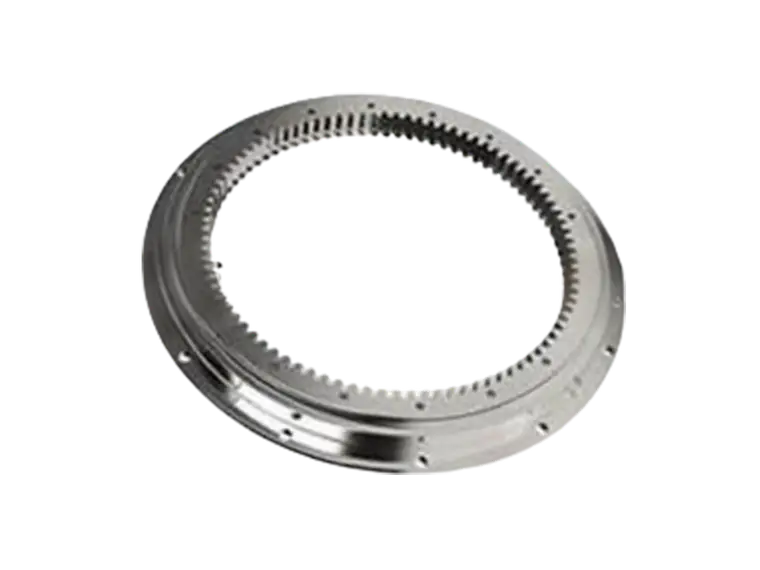
The defining feature of a crossed roller bearing is the arrangement of its cylindrical rollers. Rather than positioning rollers in a single direction, the rollers are arranged at 90-degree intervals to one another, alternating in a crossed pattern around the raceway. Spacers or a cage separate adjacent rollers to prevent skewing and maintain consistent spacing.
The 90-Degree Alternating Arrangement
Because rollers alternate between two perpendicular orientations, each roller contacts the raceway along a line rather than a point. One set of rollers handles axial loads in one direction while the other set handles radial loads and axial loads in the opposite direction. The result is a bearing that supports loads from every direction within a single, compact unit.
Line Contact and Load Distribution
Unlike ball bearings, which contact the raceway at a single point, cylindrical rollers contact along a line. This line contact distributes force over a larger area, reducing contact stress and allowing the bearing to carry heavier loads without permanent deformation. In a crossed roller bearing, this advantage is multiplied because the load is shared across multiple rollers simultaneously engaged in different orientations.
…
For more details on why crossed roller bearings excel in rotary tables, please click here: https://www.prsbearings.com/news/crossed-roller-3/