
Crossed roller bearings deliver the stiffness and rotational accuracy that machine tools, robotics, and metrology equipment demand. Yet those same qualities make them unforgiving during installation. A few micrometers of misalignment, uneven preload, or contamination at the mounting surface can raise runout, generate heat, and cut service life short. This guide outlines practical mounting steps that help engineers and technicians preserve the precision built into every crossed roller bearing.
Why Crossed Roller Bearings Are Sensitive to Mounting Errors
Unlike deep groove ball bearings that tolerate some misalignment without immediate consequences, crossed roller bearings rely on line contact between cylindrical rollers and raceways. The rollers alternate in a 90-degree crossed arrangement, allowing one bearing to handle radial, axial, and moment loads simultaneously. That design delivers high rigidity, but it also means any mounting deviation transfers directly to the rolling contact zone.
The geometry leaves little room for error
Because the rollers are preloaded against flat raceways, the bearing’s internal clearance is measured in microns. When the housing or shaft face is not parallel within specification, the outer or inner ring distorts. The distortion redistributes load unevenly across the rollers, concentrating stress on a few contact points and causing premature fatigue. Rotation accuracy suffers as a result, showing up as axial runout or radial wobble.
Temperature compounds the problem. A bearing installed with uneven preload will generate localized heat during rotation. That heat expands the rings differently, which can either increase preload to dangerous levels or reduce it until clearance appears. Both outcomes degrade precision.
Preload, clearance, and stiffness
Preload is the small axial force applied to eliminate internal clearance and increase rigidity. In crossed roller bearings, preload is typically set by the bearing manufacturer or achieved through shimming and adjustable mounting structures. Too little preload leaves clearance that allows deflection under load. Too much preload raises friction torque and accelerates wear. The mounting process must preserve whatever preload condition the application requires, without introducing additional stress.
Pre-Installation Checks and Preparation
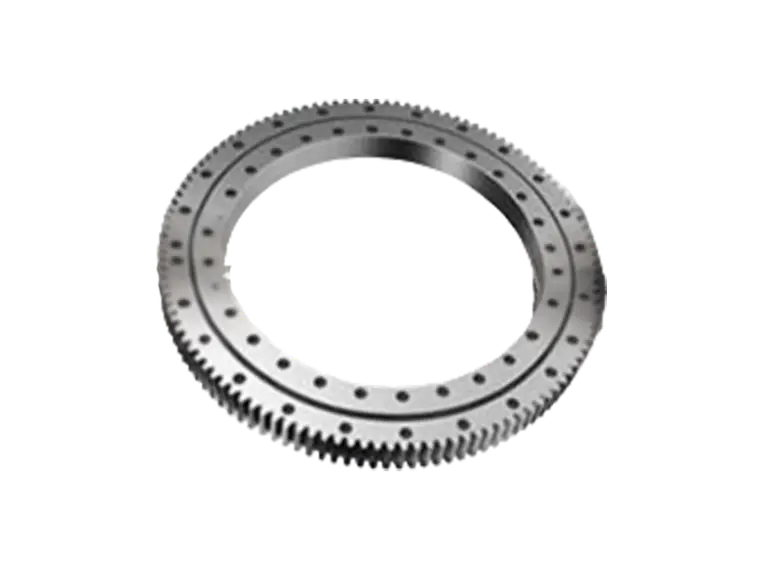
Precision begins before the bearing touches the shaft. Preparing the mating components correctly prevents most installation-related failures.
Inspect the bearing and mating surfaces
- Verify the bearing part number, internal clearance, and preload specification against the application drawing.
- Check the shaft shoulder and housing face for flatness, perpendicularity, and surface finish. Typical requirements call for flatness within a few micrometers and surface roughness below Ra 0.8.
- Look for burrs, nicks, or handling damage on the bearing rings. Even a slight raised edge on a mounting face can tilt the ring.
- Confirm that the housing bore and shaft diameter meet the specified tolerance range. Interference fits that are too tight distort the outer ring; fits that are too loose allow creep.
Clean the environment and components
Contamination is a leading cause of early bearing failure. Clean the mounting area with lint-free wipes and an approved solvent. Avoid compressed air that may carry moisture or particles. If the application demands extreme precision, perform the installation in a controlled environment where temperature and airborne particles are managed. Allow the bearing and mating parts to reach room temperature before assembly to avoid thermal expansion errors during fit-up.
…
For more detailed information on installation techniques for precision crossed roller bearings, please click here: https://www.prsbearings.com/news/bearing-mount-tips/