
In modern infrastructure development, tunnel construction has become one of the most demanding engineering disciplines, particularly as urban transportation networks, underground logistics corridors, and hydroelectric systems continue to expand. Among all construction components, tunnel formwork plays a decisive role in shaping structural accuracy, long-term durability, and construction efficiency. The precision engineering behind tunnel formwork dimensions is not simply a technical requirement; it is a fundamental condition that determines whether a project can achieve safety, alignment stability, and cost control over its entire lifecycle.
This article explores how precision engineering is applied to tunnel formwork systems, why dimensional accuracy is critical, and how advanced manufacturing and installation practices ensure consistent results in complex underground environments.
The Role of Tunnel Formwork in Modern Construction Systems
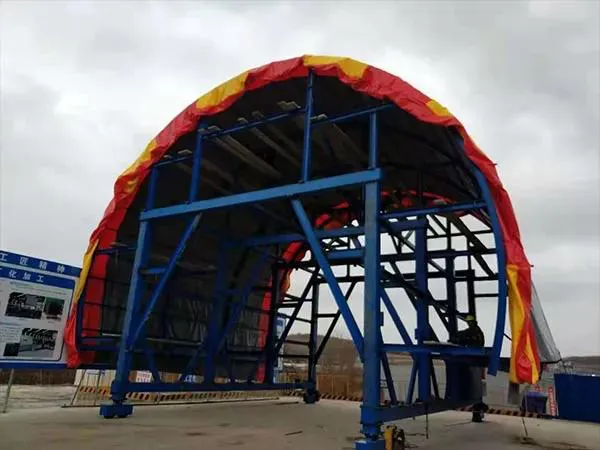
Tunnel formwork is the temporary or semi-permanent structural system used to shape concrete during tunnel lining construction. It defines the internal geometry of the tunnel, controls the surface quality of concrete, and ensures that structural loads are evenly distributed during curing.
In practical engineering applications, tunnel formwork is expected to maintain strict dimensional stability under multiple constraints, including concrete pressure, temperature variations, vibration during pouring, and continuous reuse cycles. Any deviation in dimensions, even at a millimeter level, can lead to cumulative alignment errors across long tunnel sections.
Because modern tunnels often extend for several kilometers, precision engineering is essential not only for individual segments but also for the continuity of the entire structure.
Why Dimensional Precision Matters in Tunnel Formwork
Precision in tunnel formwork dimensions directly affects several critical aspects of construction performance.
First, structural integrity depends heavily on geometric consistency. When formwork dimensions are inaccurate, the resulting concrete lining may experience uneven stress distribution. Over time, this can contribute to cracking, deformation, or reduced load-bearing capacity.
Second, installation efficiency is closely linked to dimensional accuracy. Contractors working in confined underground spaces rely on formwork systems that can be assembled quickly and aligned correctly without excessive adjustment. Poor dimensional control increases installation time and labor costs while reducing overall project efficiency.
Third, alignment accuracy plays a crucial role in multi-section tunnel projects. Modern tunneling methods such as NATM (New Austrian Tunneling Method) or segmental lining systems require precise connection between consecutive sections. Even minor deviations in formwork geometry can cause misalignment, which becomes increasingly difficult to correct as the tunnel progresses.
Finally, surface quality is also influenced by precision engineering. A well-calibrated formwork system produces smoother concrete finishes, reducing the need for post-processing and improving long-term durability against water ingress and environmental exposure.
Engineering Principles Behind Precision Tunnel Formwork Design
The design of tunnel formwork systems is based on a combination of mechanical engineering, material science, and geometric modeling. Engineers must ensure that every component maintains strict tolerances while also being robust enough to withstand repeated use.
One of the primary design principles is structural rigidity. The formwork must resist deformation under fresh concrete pressure, which can vary significantly depending on pouring height and mix composition. To achieve this, engineers use reinforced steel frames and optimized support ribs that distribute load evenly across the structure.
…
To learn more about why precision determines the quality of modern tunnel construction, please click here:https://www.gf-bridge-tunnel.com/a/blog/precision-engineering-for-tunnel-formwork-dimensions.html