
Thin section bearings are widely used in industries that demand compact structures, lightweight components, and high accuracy—such as robotics, aerospace systems, semiconductor equipment, medical devices, and automated machinery. Their unique geometry makes them ideal for designs with limited space, but this same advantage also introduces stricter requirements for installation, operating conditions, and maintenance.
When a thin section bearing fails, the consequences can be far more serious than with conventional bearings: equipment downtime increases, precision is compromised, and repair costs escalate. Understanding why these failures occur and how to prevent them is therefore essential for engineers and machine operators.
Typical Failure Causes of Thin Section Bearings
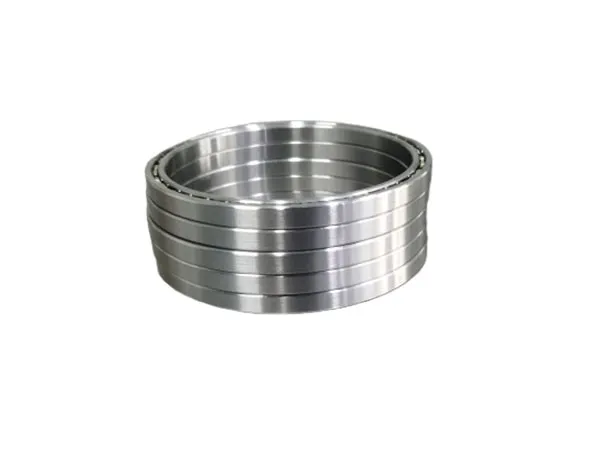
1. Misalignment Under Tight Installation Conditions
Thin section bearings are far less tolerant of misalignment because of their narrow cross-section.
Even a minor angular or parallel shift can cause uneven stress distribution.
Rolling elements begin to contact the raceways in a concentrated area rather than distributing the load evenly.
Over time, this leads to accelerated wear, vibration, and eventual spalling.
In robotic joints or precision platforms, even fractional misalignments can shorten bearing life dramatically.
2. Contamination in Compact Operating Environments
Thin section bearings often work inside assemblies where space is extremely limited. This increases the chance that:
Dust, machining debris, metal chips, or moisture enter the bearing cavity.
Contaminants scratch the raceway surface and create micro-pitting.
Lubricant deteriorates faster, turning abrasive and causing rolling-element fatigue.
In cleanroom or medical applications, contamination is one of the most common root causes of failure.
3. Load Beyond the Rated Capacity
Thin section bearings are carefully engineered for specific radial, axial, and moment loads. When these limits are exceeded:
Brinelling marks—small permanent indentations on raceways—may appear.
In heavy-duty cases, the bearing may crack or deform.
Moment load miscalculations are particularly common in rotary tables and robotic arms.
…
For more detailed information on failure analysis and solutions for thin-section bearings, please click to visit: https://www.lynicebearings.com/a/blog/thin-section-bearing-failure-analysis-and-solutions.html